Triton’s Blade Integrated Collision Detection project, led by Emma Cotter, Molly Grear, and Abigale (Abby) Snortland, is a laboratory experimentation effort that explores the use of strain gauges to detect potential animal interactions with scaled underwater turbines. The project is currently working to determine whether collisions can be detected in non-idealized and realistic turbulent flow conditions.
The Blade Integrated Collision Detection team completed collision-simulation testing at the University of Washington Harris Hydraulics Laboratory Flume using four different turbulence conditions and two different animal model sizes. Approximately 740 simulated collision cases with the models were recorded in synchronized video and strain measurements. The team is now annotating their dataset and looks forward to further analysis and beginning to draw conclusions!
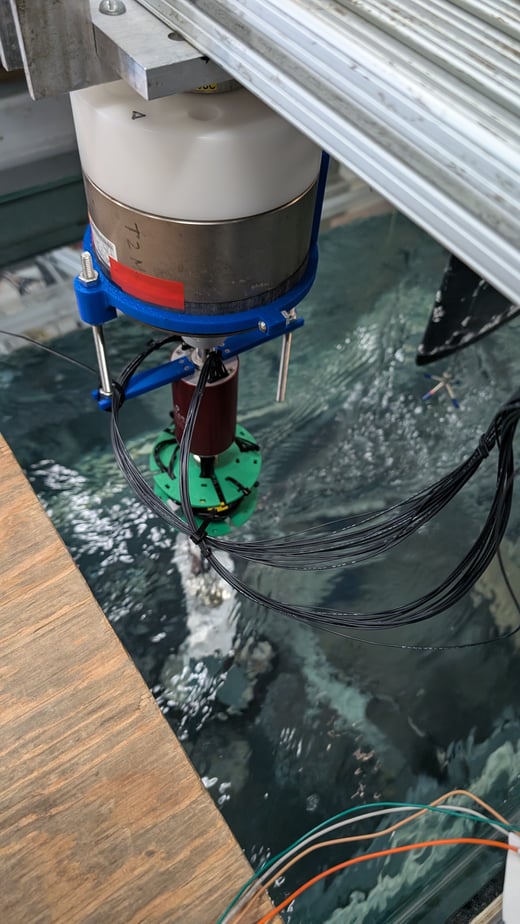
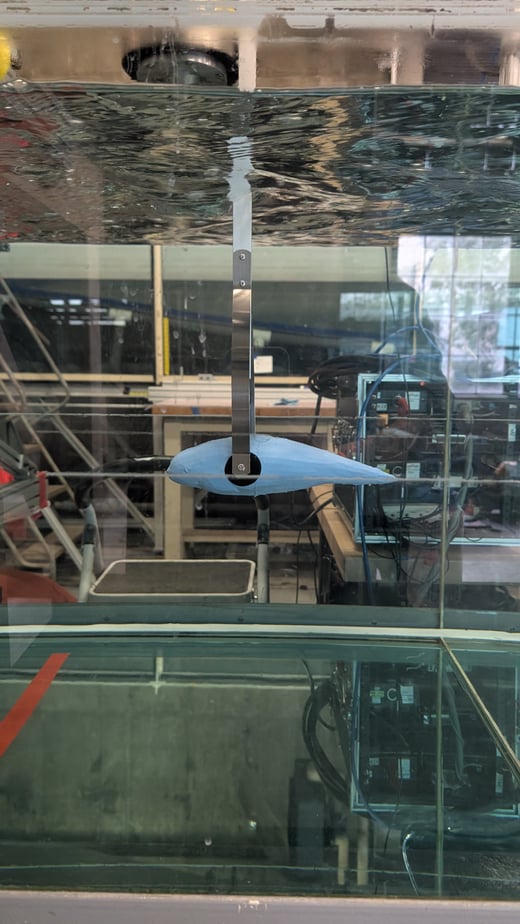
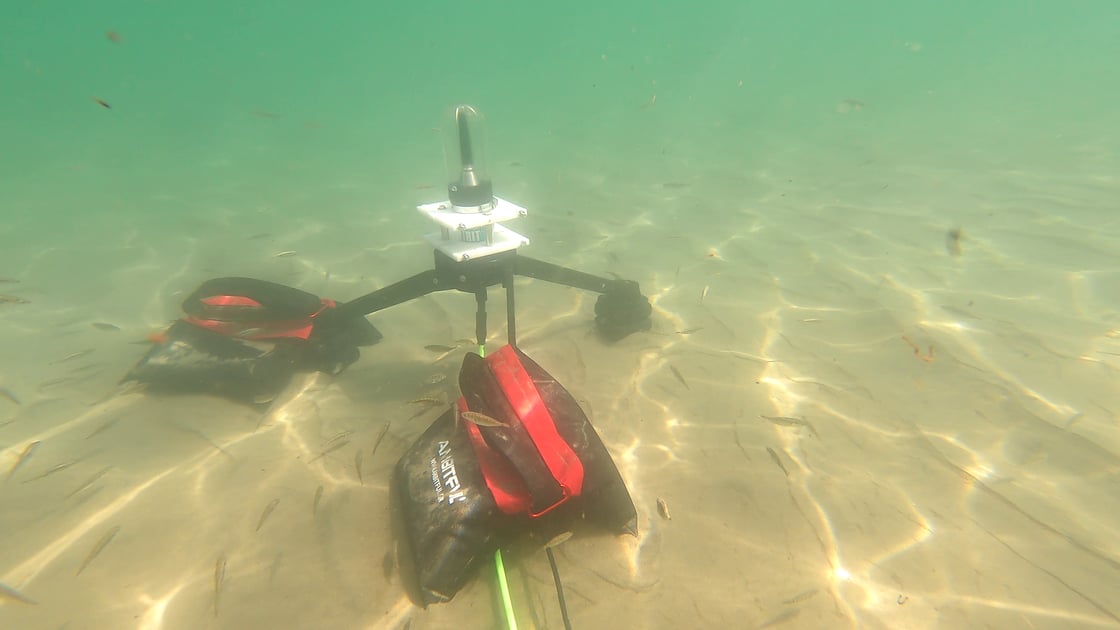
Instrumented turbine in the flume with cabling routed through the slip ring (left). Large whale model, lovingly named Whaleon Jennings, loaded for launch (right). (Photos by Abby Snortland | PNNL)
Testing Sonar in the Lab
The Imaging Sonar Capabilities project, led by Emma Cotter and Garrett Staines, is working to characterize the capabilities and limitations of imaging sonars for monitoring potential fish collision events. Through this study, they will develop a publicly available dataset that includes artificial targets approaching an operational tidal turbine.
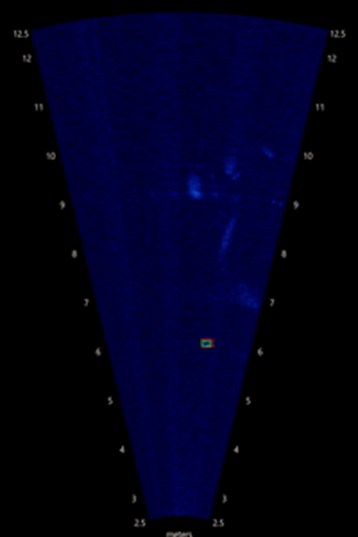
Last year, the team traveled to the University of New Hampshire, where they tested two different imaging sonars that are frequently used for environmental monitoring at marine energy sites (the Sound Metrics Corporation ARIS 3000 and the Tritech Gemini 1200ik). These tests enable the team to compare a higher-cost, higher-resolution imaging sonar that has a smaller field of view with a lower-cost, lower-resolution imaging sonar that has a larger field of view. Through this testing, they hope to develop a better understanding of the capabilities and limitations for detecting small, fish-sized targets around riverine and tidal turbines.
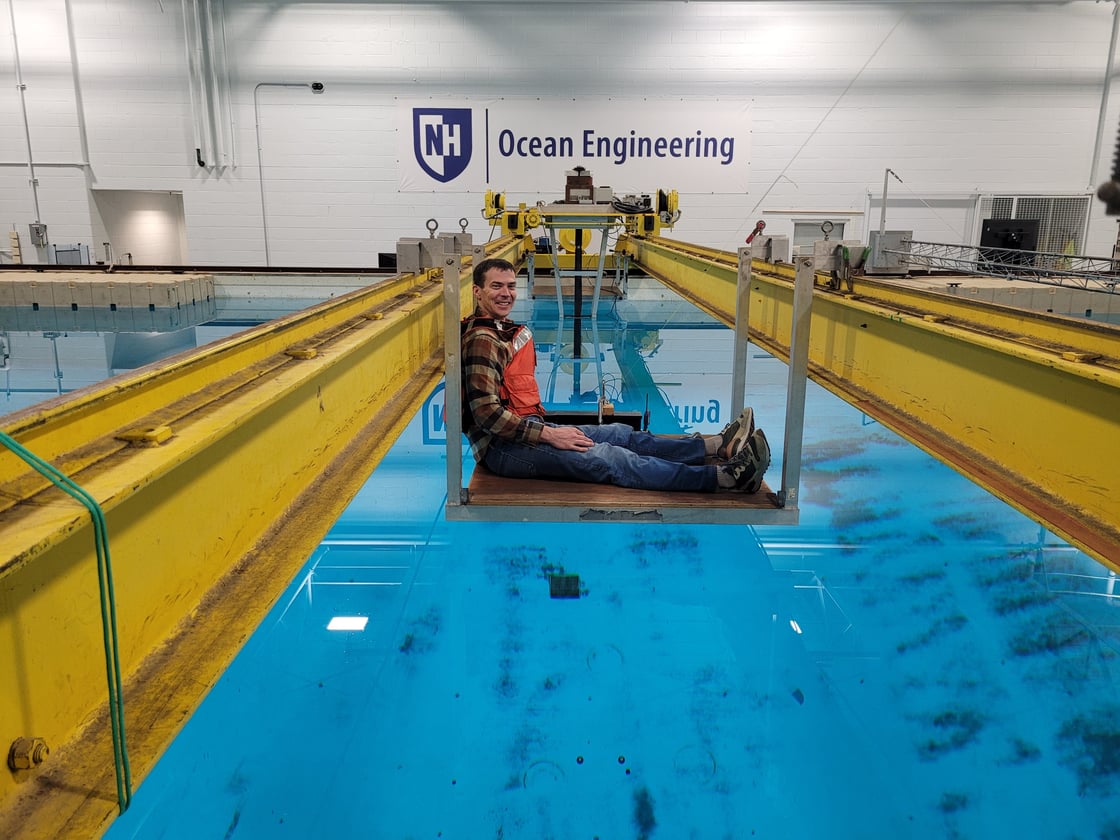
Garrett monitors the sonar progress during tests at the University of New Hampshire. (Photos by Emma Cotter | PNNL)
Triton News
New Journal Publication: The PNNL-TUNAMELT Dataset and Computer Vision Pipeline for Automated Interactions Detection
Researchers Ted Nowak and Garrett Staines recently published a paper from Triton’s Collision Risk Data Processing effort, titled “PNNL-TUNAMELT: Toward automating the detection of interactions with marine energy devices using acoustic camera sensors.” In it, they release the first, publicly available, labeled dataset of marine life interactions around underwater marine energy converters, providing open access to critical training and evaluation data for future collision risk model development and comparison. In addition, they propose a novel image-processing pipeline for filtering out turbine motion from video, which has historically confounded most existing detection and monitoring methods.
You can read the paper here and access their open-source computer vision code and dataset here!
Example acoustic camera image from the PNNL-TUNAMELT dataset that shows a marine creature (labeled in red) near the underwater turbine (center right) being detected in green.
In Other Energy News
Passive Acoustic Monitoring of a Riverine Turbine with Stationary Hydrophones
Researchers Emma Cotter, Joe Haxel, and James McVey recently coauthored a report presenting results from passive acoustic monitoring conducted around a cross-flow riverine turbine in the Kvichak River near Igiugig, Alaska, as part of the Nereus Project. Titled “Passive Acoustic Monitoring of a Riverine Turbine with Stationary Hydrophones,” the report presents findings that shed light on the acoustic properties of current energy converters and the complex sound propagation dynamics within river environments.
Stationary hydrophone used to collect data in the Kvichak River in Igiugig, Alaska. (Photo by Joe Haxel | PNNL)
Underwater Cameras and Tidal Turbines in Sequim Bay, Washington
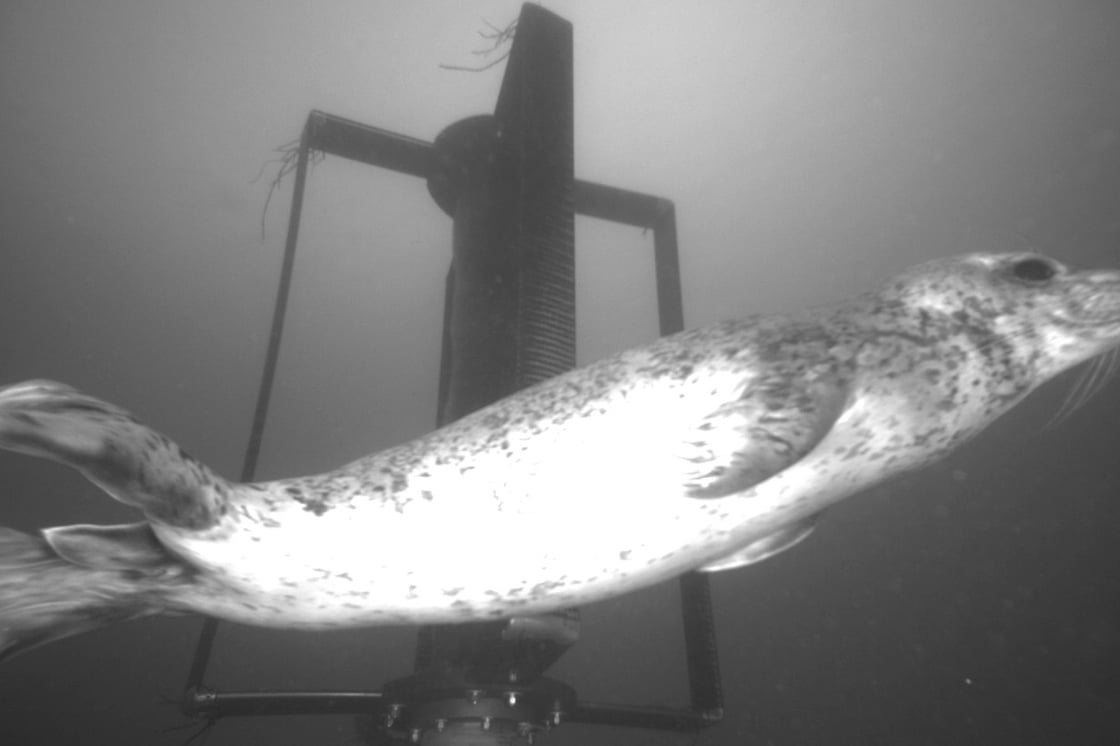
Emma Cotter led a paper recently published in PLoS One titled “Observations of marine animal interactions with a small tidal turbine.” This paper presents the results of a sensor package including optical cameras used to monitor animal interactions with a small-scale cross-flow tidal turbine, which was deployed in Sequim Bay for 141 days. Analyzing 1,044 observations of fish, fish schools, seabirds, and seals in proximity to the turbine, Cotter and coauthors did not identify instances of collision with seabirds or seals. In addition to observing collision risk, this paper also presents lessons learned on sampling mechanisms and the use of machine learning to assist in detecting underwater animals.
This research was also highlighted in a recent article published by Inside Climate News, which emphasized the applications of AI-driven software to monitor underwater animal activity and the need for additional studies to monitor the environmental impact of larger, grid-scale turbines. Read the Inside Climate News article here.
An underwater acoustic camera captures a harbor seal interacting with a tidal turbine in Sequim Bay, Washington. (Photo provided by PNNL)
Recent Outreach from OES-Environmental
OES-Environmental recently engaged with U.S. stakeholders and regulators to share knowledge on the environmental effects of marine energy. The San Juan County Marine Resources Committee (Washington State) invited OES-Environmental to deliver a webinar presenting background information and the latest research on environmental effects of marine energy.
The Washington Department of Fish and Wildlife subsequently hosted a webinar in which OES-Environmental presented project-developed approaches and materials that can be used to evaluate environmental effects and support marine energy permitting processes. In addition, OES-Environmental, in collaboration with the University of Washington, hosted a webinar for U.S. regulators focused on marine animal interactions with tidal energy turbines.
This webinar highlighted ongoing U.S. and international research and featured a presentation by Dr. Chris Bassett on observations from a tidal turbine deployment in Sequim Bay, Washington.
Triton is designed to support the development and testing of more precise and cost-effective environmental monitoring technologies for marine energy. Pacific Northwest National Laboratory leads Triton on behalf of the Department of Energy’s Water Power Technologies Office.
Connect With Us
Pacific Northwest National Laboratory, 902 Battelle Blvd, Richland, WA 99354