The projects under the Triton Initiative, similar to the tides, experience ebbs and flows. As we transition to spring, many of our projects are in an ebbing phase as they prepare for the flows of summer work. Our researchers are working hard to analyze data and begin drafting papers as they await summer weather for field research. We will continue to provide updates and share findings as projects move along!
Gearing Up: Preparing Substrate Vibration Exposure Experiments with Crabs
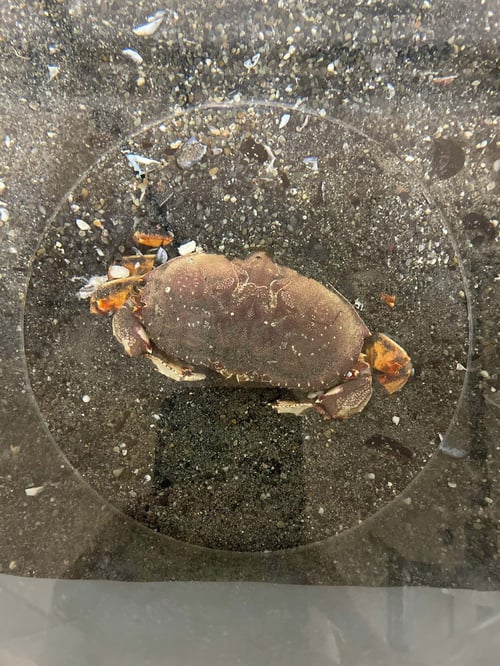
Male Dungeness crab (legal catch size) and arena for substrate vibration exposure experiment (Photo by Tristen Myers Stewart | PNNL).
Triton’s Acoustic Particle Motion project is ramping up the next phase of experiments addressing the effects of substrate vibration on Dungeness crabs. The team will soon begin exposure experiments in tanks at PNNL-Sequim. This project will research the behavioral responses of crabs when presented with different acoustic stimuli.
Meet Tristen and Emma, the researchers leading these tank experiments.
Tristen Myers Stewart is an Earth scientist at PNNL-Sequim, where she works on a range of marine research projects, including eelgrass monitoring, unexploded ordnance remediation technologies, addressing dissolved gases in the marine environment, and water quality monitoring. She is also on PNNL’s field operations and dive team. Through Triton, Tristen is the task lead for crab husbandry and data collection. This work involves caring for and feeding the crabs, as well as documenting behavioral responses to sediment vibration stimuli. During this experiment, the crabs will be placed in an arena, exposed to substrate vibrations, and monitored for a response to the signal.
Emma Geon is a marine electrical engineer who specializes in electronics design and system integration supporting marine energy systems, offshore observation, and marine robotics. For the dose response experiment, she leads the design and implementation of the experiment’s electrical system to achieve the required substrate vibration exposure conditions and meet sensor data collection objectives. Her work includes integrating observational sensors like accelerometers, a particle motion sensor, and cameras as well as the stimulus side of the experiment that uses an amplifier and dynamic shaker. The sensor and instrument data streams are piped into a centralized control program. The software controls shaker frequency and amplitude and captures real-time measurements of substrate conditions and crab behavior.
UW News Highlights Triton’s Collision Research
The Blade Integrated Collision Detection project, led by Emma Cotter, Molly Grear, and Abigale (Abby) Snortland, explores the use of strain gauges to detect animal collision with underwater turbines. In collaboration with the Pacific Marine Energy Center and the University of Washington (UW) Harris Hydraulics Laboratory, the team conducted experiments, releasing a silicone marine mammal model in flowing water upstream from a small turbine to better understand—and ultimately help mitigate—collisions. These experiments were recently highlighted in a profile and video by UW News, check it out here!
Triton News
What Do You Want to Know About Marine Energy?
Triton’s Communication, Outreach, and Engagement team is working to develop another Marine Energy 101 explainer series, and we want to hear from you! If you have questions about marine energy and environmental effects, if there are questions you commonly receive, or you have suggestions for new topics we should cover, please let us know by filling out the form here.
Attend the Panel Discussion About Marine Energy Careers
The Triton team will be attending the 2026 Ocean Renewable Energy Conference in May and we’re leading a workshop about environmental effects perceptions and communications needs! Mark your calendars for our workshop titled “From Risk to Readiness: Mapping Environmental Effects and Information Needs” at 1pm PT on Tuesday May 19th. Register for the conference here: https://pacificoceanenergy.org/orec/#agenda
Stay tuned for more information about the workshop!
In Other Energy News
Developing and Applying an Environmental Risk Register
PNNL researchers Mikaela Freeman and Hayley Farr, alongside Triton’s Joe Haxel and Garrett Staines, recently published a paper in Ocean & Coastal Management titled “Development and Application of an Environmental Risk Register for Marine Energy Device and Project Developers.” This paper showcases the creation of an environmental risk register, which aims to help device and project developers identify and assess potential environmental risks early in device design or planning, document and track potential environmental interactions, prioritize risks and determine mitigation measures, and support decision-making throughout the lifetime of the device or project development. The authors also apply the environmental risk register to two different use cases—wave energy and tidal energy—to provide example results. Read the paper here!
Standardizing Metrics for Monitoring Baleen Whales
PNNL post-doc Angela Szesciorka, along with researchers from PNNL and the National Laboratory of the Rockies, recently published a paper in Ocean & Coastal Management titled “A Call to Standardize Metrics for Monitoring Baleen Whales Near Marine Construction Activities.” This paper provides a minimum set of metrics related to efficacy, detection range, and data delivery recommended to assess the utility of monitoring technologies. Szesciorka and coauthors, including Triton’s Joe Haxel and Michael Richlen, also emphasize the benefits of multi-modal approaches and recommend performance assessments through modeling or large-scale collaborative field testing. Check out the paper here.
New Environmental Resources
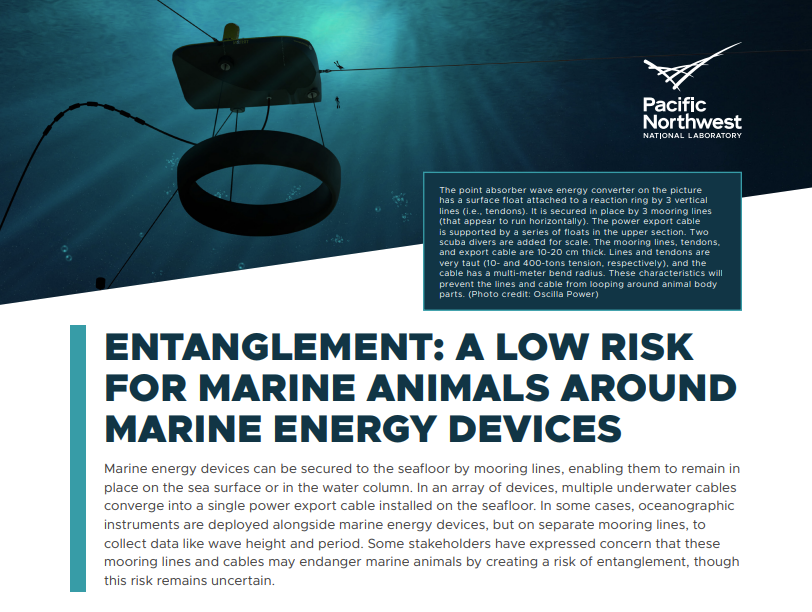
Researchers from PNNL and the Atlantic Marine Energy Center (AMEC) recently published a new fact sheet on entanglement risk and marine energy. Entanglement may occur due to the interactions between marine animals and mooring lines, or marine animals interacting with marine debris caught on the mooring systems. For more information on the status of knowledge, uncertainties, and future research related to entanglement, read the fact sheet here!
Additionally, the OES-Environmental team at PNNL, in support of AMEC, recently released a new video that described the entanglement risk associated with marine energy mooring lines and cables. You can watch the video here!
OES-Environmental Regulator Surveys
OES-Environmental is releasing their second iteration of regulator surveys, which aim to understand how regulators perceive and manage environmental risks during consenting processes for marine energy projects. These surveys worked to understand regulators’ familiarity with marine energy technologies and perceptions of potential environmental risks associated with marine energy development, while also working to understand the use of Tethys. The first two reports from this iteration are now published, which summarize results from the United Kingdom,United States, and Ireland regulator surveys. More information about this effort can be found here.
Triton is designed to support the development and testing of more precise and cost-effective environmental monitoring technologies for marine energy. Pacific Northwest National Laboratory leads Triton on behalf of the Department of Energy’s Hydropower and Hydrokinetics Office.
Connect With Us
Pacific Northwest National Laboratory, 902 Battelle Blvd, Richland, WA 99354
.png?upscale=true&width=1120&upscale=true&name=Newsletter%20%26%20Social%20Graphics%20%20(16).png)